All posts
Effective Revision Strategies: Science-Backed Techniques
Kaushik · 22 Nov 2025 · 8 min read
RevisionExamsLearning ScienceStudy Tips

Active Recall
Test yourself. Close the book and try to write down everything you remember. Then check. This forces your brain to retrieve information, strengthening neural pathways.
Spaced Repetition
Don't cram. Review material at increasing intervals: 1 day later, 3 days later, 1 week later. This combats the 'forgetting curve'.
Interleaving
Mix up your subjects. Don't study just History for 5 hours. Study History for 1 hour, then Biology, then Math. This helps your brain distinguish between different types of problems.
Dual Coding
Combine words and visuals. Draw diagrams, mind maps, or timelines to represent the information. This gives your brain two ways to find the memory.
Check your own draft before you hand it in.
Grade my assignmentMore from the blog
20 Nov 2026· 4 min read
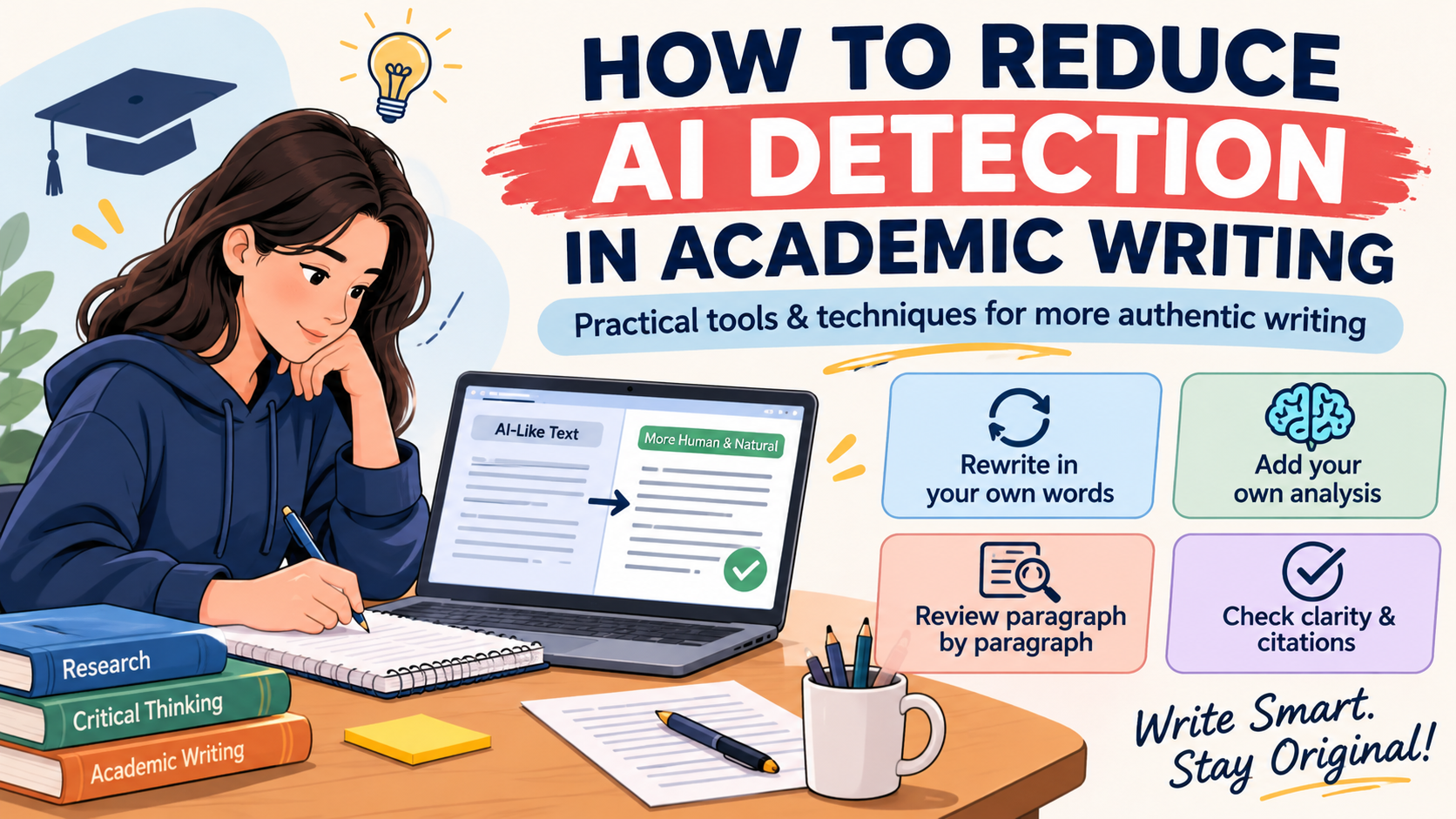
How to Reduce AI Detection in Academic Writing: Tools and Techniques Students Can Use
AI tools have become a part of academic writing, helping students brainstorm ideas, structure assignments, summarise research and improve grammar. However, with universities and publication houses increasingly using AI detection tools, students are also becoming concerned about how their submissions are evaluated. A high AI detection score doesn't necessarily mean a student has cheated. AI detectors can make mistakes, and even Turnitin acknowledges that its AI detection may misidentify human-written or AI-written text.

12 Nov 2026· 4 min read
Why Students Lose Marks Even When They Answer the Assignment Question Correctly: Understanding University Marking Rubrics
Discover why answering an assignment question correctly isn't enough to score high marks. Learn how university marking rubrics work and how to improve your academic grades.